
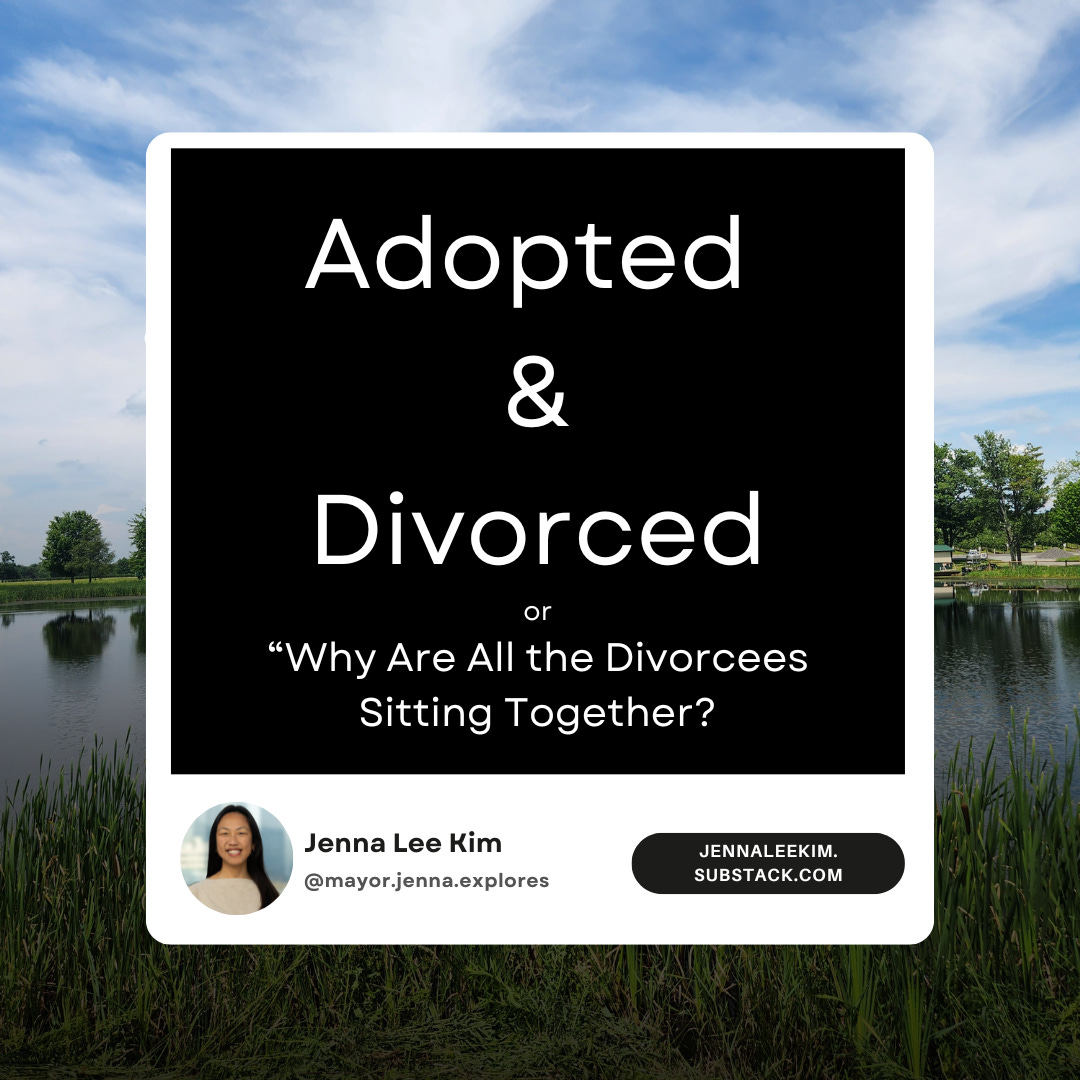
Why Are All The Divorcees Sitting Together?
Exploring insights and advice from inside the adoption identity journey... and how to include your partner

I went to the bank this past summer to move around some accounts. I was there with my kids and their dad. At the end of some tedious internal banking processes, he stepped out to take them for some Rita’s Italian ice while I waited for the bank’s computer system to do its thing and print out some paperwork. The associate helping us smiled at me, making idle and polite small talk. “What a cute family,” she said. “Your kids are so well-behaved.”
The ultimate compliment.
“Thanks!” I paused.
I could have let it go.
There would have been no harm to anyone if she went on believing the story in her head. Instead, I said it out loud. “Actually, we’re doing all of this because we’re getting a divorce.”
It was the first time I’d said the words out loud on American soil. It was maybe the first time I’d told a stranger, period. The words felt strange. A new label. A new stage of life. Another transition. Another thing to explain.
She didn’t hide the surprise on her face, more-or-less asking with her expression and her words: Are you sure you want to do this?
I chuckled and replied with something neutral and benign, meant to make all of us feel more comfortable, a people-pleasing habit. It’s the best thing for all of us. I’m a different person now. I’m happy.
Something behind this woman’s eyes changed as she put aside the polite small talk and switched into Girlfriend Mode. “You know, I have thought about this for years,” she leaned forward, her voice low. “He doesn’t pay attention to me anymore. I walk around on eggshells. We’ve been living different lives for years. He feels like a roommate. I just want to be free.”
I didn’t bring my husband along on my journey.
As sometimes happens to me, my own act of confiding and disclosing landed me in a position of confidante and sounding board. I gave her the number of my therapist in Pennsylvania, and with a wink, she handed me my folder of papers from my new checking account and wished me well.
And here I am.
In a new club that no one hopes to or believes they’ll ever be in.
3 out of the 8 couples on my old block in the Philadelphia suburbs have separated and divorced in the 2 years since I moved to Korea. I’m in a group chat with some fellow Korean adoptees who I met on a motherland tour 3 years ago. 6 out of 7 of us are divorced or separated. I have three close friends named Amanda who got a divorce in the past 12 months. Three! I had to give them nicknames to keep them all straight when chatting with other friends. And being open about my relationship status to others has only released the floodgates of confessions from other friends - or strangers - who share that they’d be lying if they hadn’t thought about the same thing.
I check myself on these personal stats. After all, we tend to surround ourselves with people in the same stage of life with similar mindsets and interests. We go from being Single Gals. To Married People. Families with Kids. Stay-at-home Moms. I write all of these as formal titles with capital letters. Had I inadvertently surrounded myself with others who are in the same proverbial boat?
I think like everything, there are a myriad of factors leading to this stage of life and it’s not the same for everyone.
But I can’t help but notice some (totally unscientific and anecdotal) qualitative patterns.
There are a heck of a lot of us who came into consciousness about how race, adoption, and the reasons for our people-pleasing tendencies impacted our lives and decisions… and realized we were not the people we thought we were when we were young… when many of us chose a life partner.
How did I get here?
How did I get here? I had the proverbial 2.5 kids, the picket fence (okay, ours was split-board), and spent my Christmases making cookie trays for everyone in the neighborhood. I was Mama Mayor. I left my career to be the primary caretaker for our kids. I made dinner on weekdays and did the dishes. I did everything I thought I was supposed to do.
And then I “found out” I was Korean.*
And met my birth family.
And had an existential crisis (read: emotional and mental breakdown).
And I didn’t bring my husband along on my journey.
There I was, with a lot of unstructured time, earbuds, a cell phone, endless podcast interviews, access to other Korean adoptees on social media, a sparkly, brand new community of supportive people who “got it,” people who understood, and an introverted partner who supported me in the only ways he knew how, because I wasn’t giving him direction or insights for any other options.
I didn’t know those options, myself.
I won’t unpack the private details of what led to the end of my marriage, but I will say this:
There’s a cautionary tale here of taking your partner for granted.
There’s something here about routine, complacency, and believing they are the same person they were yesterday (let alone 15 years prior).
About believing it’s normal that they’re not asking or acting curious.
About not sharing or assuming they won’t “get it” or won’t try to understand.
What is it about not asking the questions or saying the thing to the person who’s closest to us… ironically, the person who should be asking or saying it to the most?
If you’re reading this and married and you know in your heart you haven’t been sharing the everyday and big pieces of your journey with your partner, start. Start now. Bring him or her along on the hard work of getting to know, listening, supporting, and holding you: the you that’s in front of them, not the you they thought you were yesterday.
Start Now.
It’s not only important, it’s imperative.
Cutting him or her out is convenient. After all, they’re locked in. You’re married. You’re stuck with each other, right? Finding new friends and connections in the adoptee community feels easier and exciting.
You’ve uncovered this huge part of yourself that is confusing and a little bit scary, and - how convenient! - there’s a whole group of people out there who can give you a soft landing with chats, dark humor, and an escape from the seriousness of things like: Finding Your Birth Family. Uncovering the Dark Side of Coercion and Corruption Within International Adoption. (Again, titles with capital letters.) Questioning every decision you’ve ever made when you thought you were white girl from New Jersey. And the urgency to catch up and figure out your new Self before… well, before it’s too late.
This isn’t like nursing a hangover in your 20s. Because now we have kids and a picket fence. People count on us to make cookie trays and to do the dishes every night after we’ve already made dinner.
And some of us do things like move to Korea while we’re riding adjacent to that eye of the storm.
Or maybe that was just me.
Putting your Self first and changing your reality for any reason - in the short term - feels scary.
Something I worked on with my therapist was, “Saying the ugly thing out loud.” Admitting to your Self - first - whatever it is you’ve been carrying around that is true, even though it goes against your public persona, what you thought were your core beliefs, and what everyone else in your life believes to be reality.
I’m not the same person I was before. We don’t have anything in common. I want different. I want more.
Thoughts like this feel awful. Selfish. Unappreciative. As women, as adoptees, as people, we can feel trapped by the gravity of our past decisions made when we were conditioned to be someone else. When everyone around you is doing their best and only trying to love you.
Every week I meet another adoptee who’s separated, divorced, or thinking about it.
Every.
Week.
Something’s going on, and it’s not a coincidence. So few things are.
So, if you’re reading this and any of this resonates with you, know that you’re in good company.
Relationship statuses aside, putting your Self first and changing your reality for any reason - in the short term - feels scary.
Pushing aside your partner and not trusting that they can hold what you need in the realm of emotional support is hard, even if it feels easier in the moment. They love you. They want to know. They want to help. Don’t leave them out. Don’t push them aside. Bring them along.
And.
Staying in any situation that hinders your ability to be the best version of your Self may seem easier now but - for the long term - will only become increasingly more difficult as time goes on.
What we have that we didn’t have when we were younger is life experience. We can’t go back and teach that younger version of us how to love ourselves better. But we can look ahead to the older version of us who wishes she’d taken that step now.
For her.
For the You in the now. For the You in the future.
To hear more about this topic, check out my friend, April Williamson’s podcast: Seoul Searching on YouTube or Spotify where we chat like sisters and keep it real like friends. Part II is coming soon.
Follow me on Instagram, Facebook, or learn about my professional background on LinkedIn or Linktr.ee.
If you have questions or comments, leave them here! I will address them - “unplugged” and unscripted - on my Spotify podcast: Exploring with Jenna Lee Kim. Stay tuned, and thanks for exploring along with me.
What an insightful and honest read. Thank you, as always, for sharing. For guiding.
Thank you for the reminder - I do need to start a conversation at home ! Just keep putting it off ..