
Korean Mermaids
Exploring how Jeju Island Haenyeo have created a feeling of awe and connection in Korea

Author’s note: If you’re interested in learning more about the Jeju Island “Sea Women,” follow my friend, Kylie Genter on Instagram where she provides amazing education and insights into life of a Haenyeo. She and I will go “live” with an exclusive Q&A on my Instagram page on Monday, May 18 at 8:00 p.m. The interview will live on my Instagram grid if you miss it!
Thanks! Read on…
I don’t remember when I first learned of the “Korean Mermaids,” “The Korean Women Divers,” or “The Korean Women of the Sea.” Haenyeo. 해녀. Sea Women.
Like everything else about the country where I was born - but not where I became me - they seemed far away and foreign, impossible to be acquainted with or understand.
Looking at me, you might be surprised by this. I have the face of a Korean. But for most of my life, it was rare that I noticed her in the mirror.
I didn’t feel close to Korea: a country with a distinct history and culture that didn’t feel like my own.
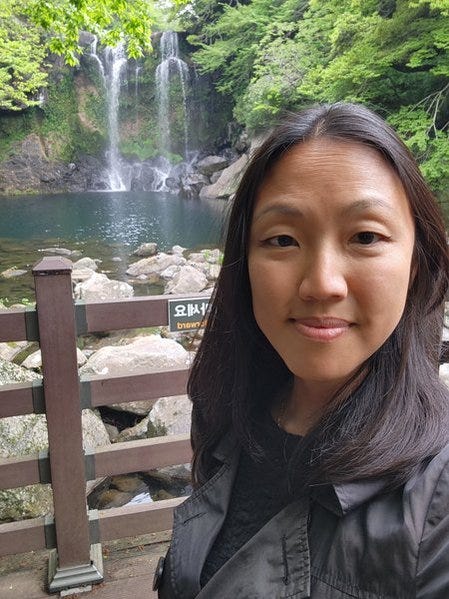
But then I unexpectedly met my birth father - my Appa - and moved with my family to Jeju Island in Korea.
Jeju Island. The island of wind, rock… and women. A place where I would - slowly - begin to observe, learn, heal, and absorb tiny connections to the land where my face blends in and belongs, though the rest of me may never catch up.
The autumn after moving to Korea, I read Island of Sea Women. Historical fiction, the author, Lisa See, spent time on the island doing research, including with a Korean American friend of mine, Brenda Paik Sunoo, a journalist and author from LA who spent time researching the culture of Haenyeo.
The book haunted me for months, scenes from the life of Jeju women who, out of necessity to feed their families, dove into the frigid cold and dangerous waters, hunting to catch abalone, octopus, sea urchin and cucumber, various shellfish, and seaweed along the shores.
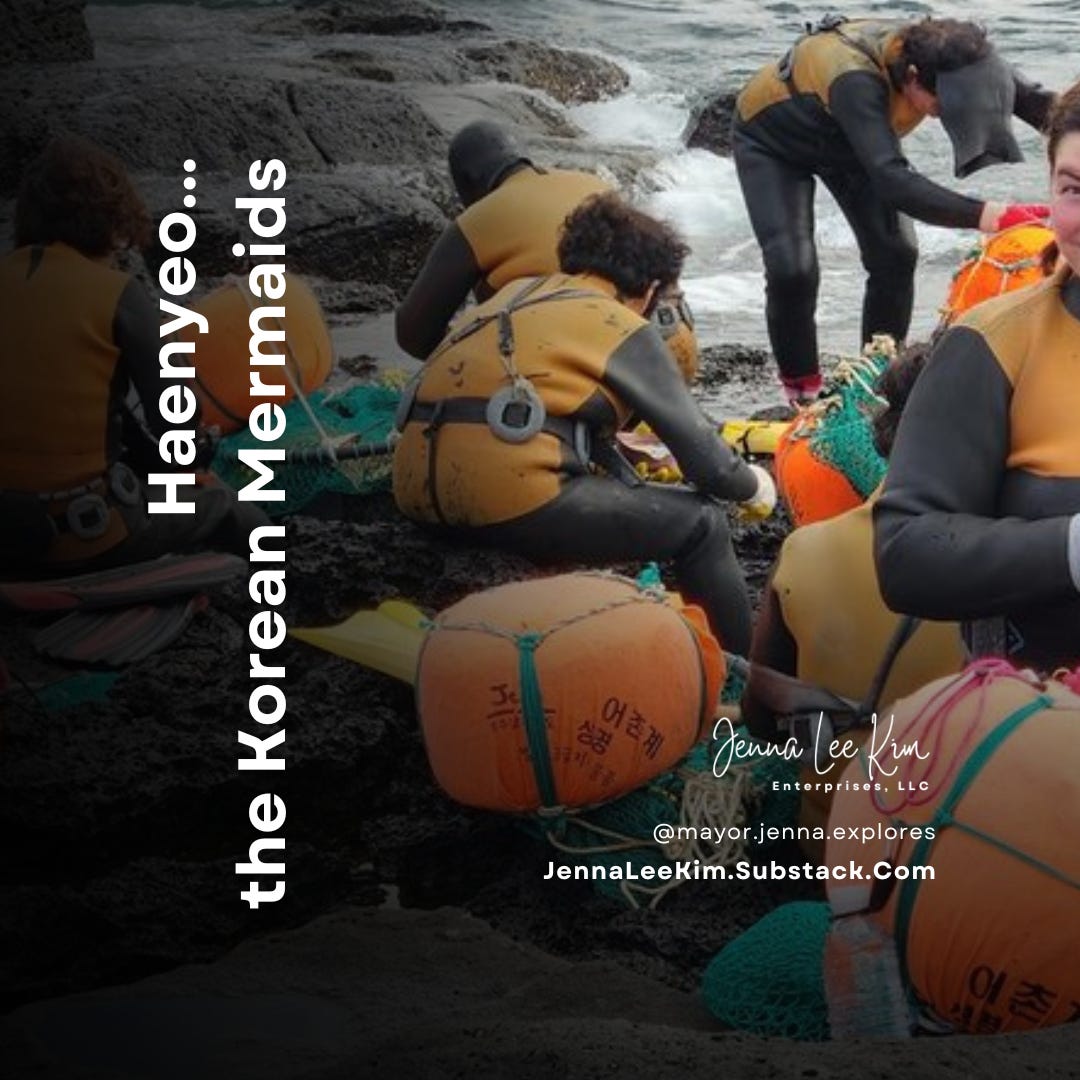
Today, they dive in rubber wet suits and flippers, but they began generations ago in short uniforms made of cotton. They won’t use air tanks, because they only want to catch what is natural and not deplete the growth and supply of seafood in their area of the ocean.
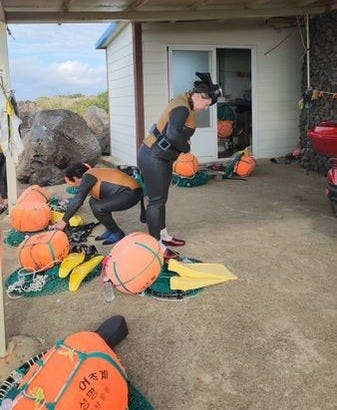
Women, with more body fat and - arguably - temperaments more conducive to the patience and mental endurance needed for sea harvesting, have been diving for generations around Korea, Japan, and even Russia. Up until the late 1900s they often began their training at age 8 or 9.
A friend of mine, Soonja, born in 1959 and raised on the island, says she could swim in the waters near Hallim before she learned to walk. I can imagine a world, so big and bright when you’re a child, surrounded by water and women who dive in the sea the same as if they were walking to the market.
Men were often taken away for military service or work on fishing boats. Women were the matriarchs of tiny villages, leading movements during Japanese occupation to fight for independence, protest taxes on what they sold from their ocean harvests, all while earning enough money to feed their families, send their boys to college, and provide dowries for their girls.
Because these women are not only part of a rich tradition, culture, and history, Korea has recognized Haenyeo as nationally recognized treasures, supported by the government with health benefits, financial assistance, and even a retirement plan (many Haenyeo retiring well into their 80s and 90s).
There is some general controversy over the world’s interest in them. Taking pictures, seeing them as some kind of a spectacle… Seeing Haenyeo stickers, plushies, and cartoonish statues in tourist shops makes me raise an eyebrow. I can’t help but compare it to coming to your place of work and taking pictures, drawing cartoons of you at your desk, and putting you on a coffee tumbler as a caricature. Their growing popularity, the interest in their work, culture, and history - beginning perhaps 15 – 20 years ago - is recent enough that I have met friends on the island who arrived before the rest of the world knew about them, and when everyone began to show curiosity.
At first, these women, tough as the lava rock around their gardens and pragmatic as the ocean is wide, were – understandably – skeptical. Maybe confused. Why would you want a “recipe” for my soups? I don’t have one. I make it to feed my family just like my mother and grandmother did before me. Women didn’t begin this for glory or recognition. They did it while pregnant. They did it while nursing. They did it for the survival of their families.
On the other hand, Koreans are full of pride in their culture, and the Haenyeo women I have met are happy to show off their skills, pleased that others are interested in them, and don’t seem to mind welcoming friends if there is respect, honest curiosity, and good conversation along with some treats to say a respectable “thank you!” for their time.
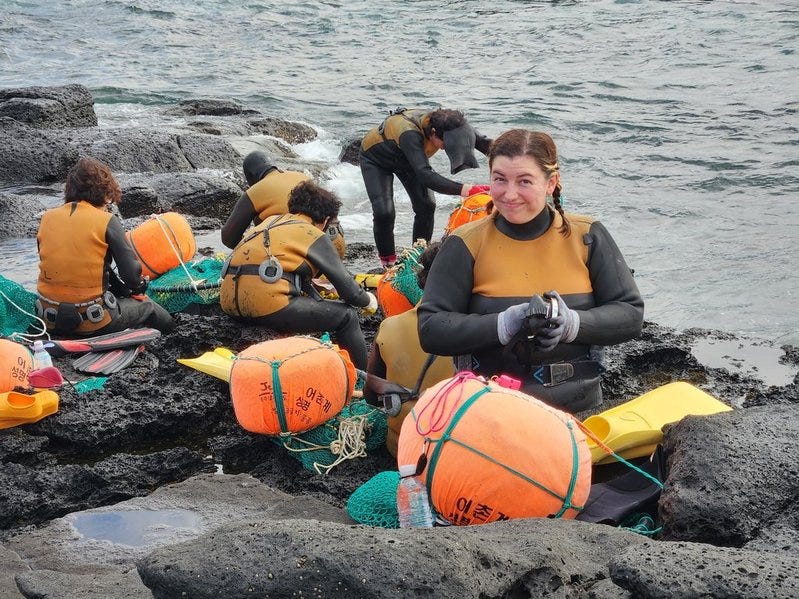
Yes, Haenyeo culture is alive and well on Jeju Island, with perhaps about 2,400 still active in fishing villages (run by a head of a fishing association) all along the coasts.
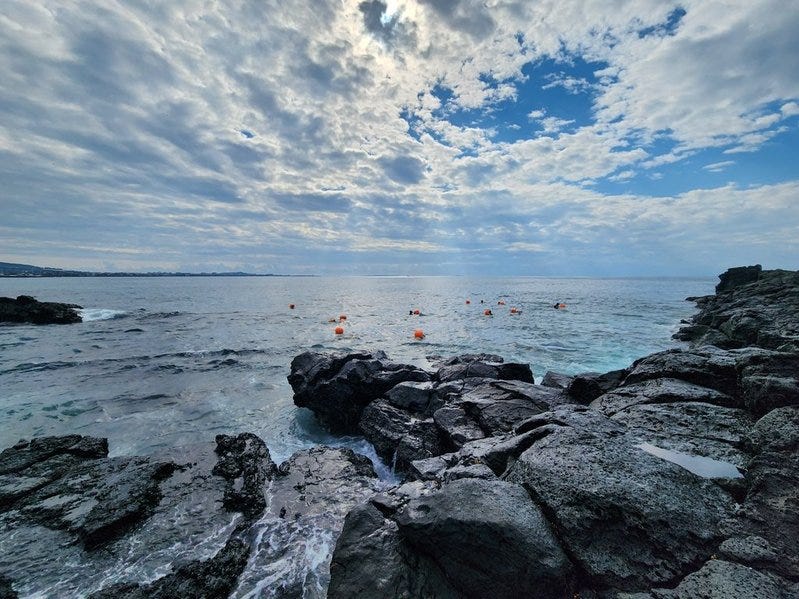
Often, when I’m out for a drive to a cafe or to do some errands, I’ll spy them on their matching motorbikes, their signature bright orange buoys or tewak (테왁) slung off their side, diving mask on top of their head, caravaning to the place they will jump into the sea for an afternoon of work. I’ve watched, flippers moving the air just above the surface as their owner’s head is 180 degrees south in the water, using her kkakkuri (까꾸리) to pull sea life off of a rock.
In the fall of 2025, I had the honor of accompanying a Korean adoptee friend to observe a typical day of diving for a local village. My friend, Kylie, now trained and certified to be Haenyeo and join this rich tradition of women, arranged for us to visit.
We walked with Kylie and her colleagues along a coastal road to an entry point. Some of the women stopped every so often, the 8 to 16 pounds of weight around their waist (helpful to make them sink in the water, but not-so-comfortable while walking on the asphalt of dry land) making their hips and knees hurt, the average age among them about 70 years old. The eldest was 93.
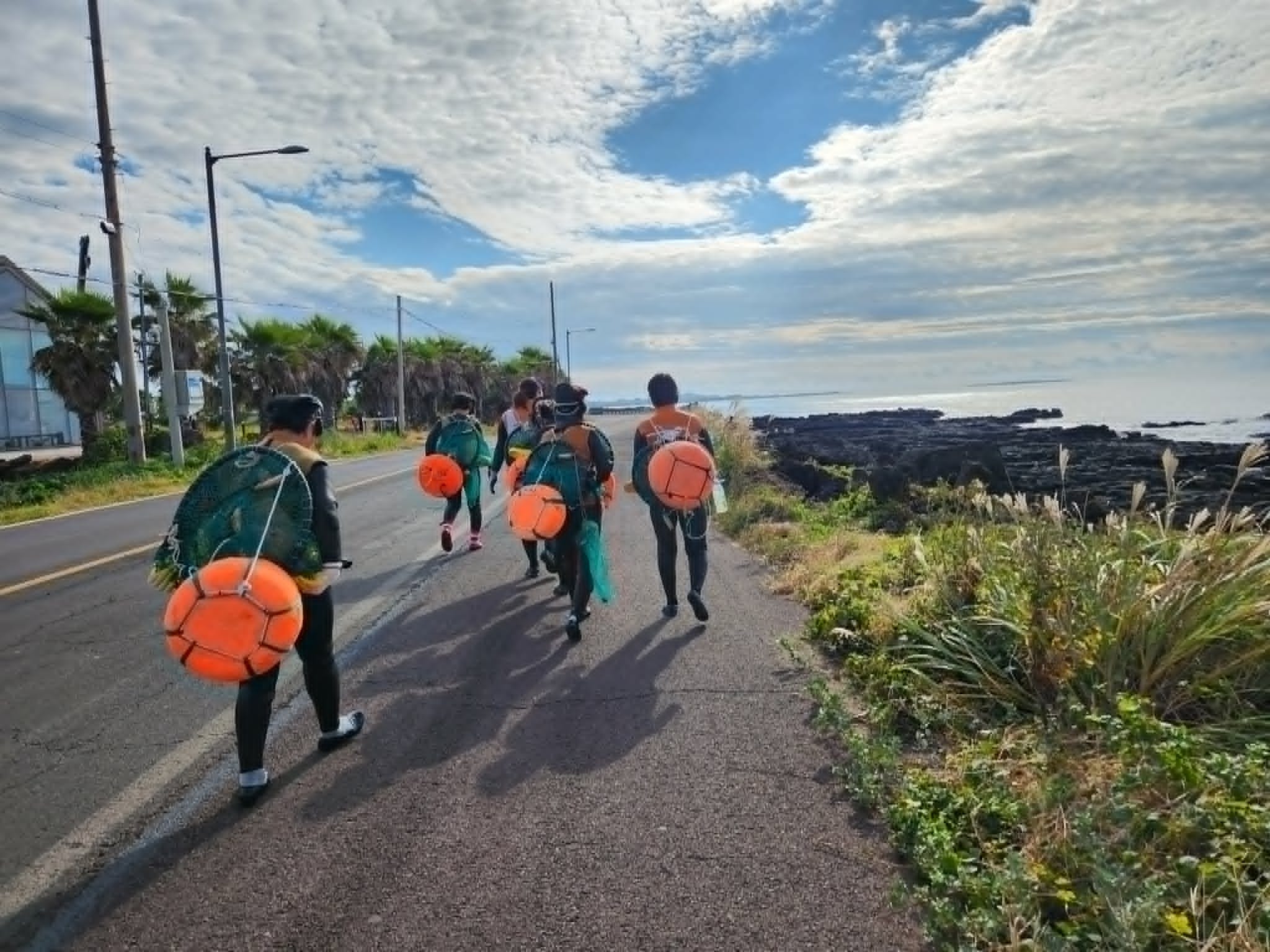
Watching these women arrive at their diving location, walk carefully over lava rock, the bright orange highlights of their wet suits like starbursts against the porous black surfaces before they unceremoniously jumped into the ocean… it is a moment I’ll always remember.
Later, Kylie - at the time known as a “Baby Haenyeo” - and I would join my friend and her Korean birth family for a visit at her maternal grandparents’ home. They treated us to lunch afterwards. Her grandparents, mother, and two siblings. Afterwards, we tagged along as they showed us greenhouses of their tangerine farm. I took family portraits for them at a local cafe overlooking the ocean.
Wow.
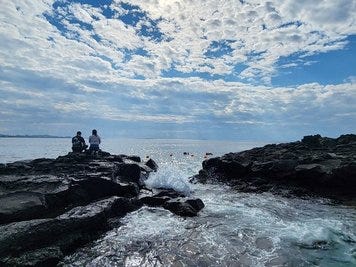
It’s these surreal blips on my personal timeline that remind me that I’m not living a typical life of a Korean adoptee or an American. I live two blocks from the ocean and 3 lighthouses, 8 minutes of a drive away from two beautiful mountains that sit by the sea, and actual mermaids who work during the winter months to feed their families.
There is something startling and bright about learning pieces of any history connected to a country and culture that - slowly - I am embracing as my own.
It’s about meeting women of Jeju Island who have told me that this island makes women strong… including me. About knowing, in the back of my mind, that my birth mother’s surname is uniquely Jejuian, and that perhaps somewhere, I have familial roots on this island, too. It’s about living in a place that is so unique with something so spectacular… and yet seen as so common among the people who live, work, and play here.
The Haenyeo are an incredible reminder to me that even in difficult times, we can still move forward in whatever village we consider to be ours - together and for one another - as we move haphazardly along the beautiful struggle of our days.


Follow me on Instagram, Facebook, or learn about my professional background on LinkedIn or Linktr.ee.
Questions? Comments? Leave a comment here and I’ll respond to it on my Spotify Podcast: Exploring with Jenna Lee Kim in an “unplugged” and unscripted way! You can also email me at jenna.tae.hee.kim@gmail.com
Incredible women. Such strength and talent